

What Animals Have Evolved Dramatically Over Time
How fast is development? In adaptive evolution, natural selection causes genetic changes in traits that favour the survival and reproduction of individual organisms.
Although Charles Darwin thought the process occurred over geological timescales, we accept seen examples of dramatic adaptive evolution over simply a handful of generations. The peppered moth changed colour in response to air pollution, poaching has driven some elephants to lose their tusks and fish have evolved resistance to toxic chemicals.
Baca juga: Explainer: Theory of development
Yet, information technology is still hard to tell how fast adaptive evolution is currently occurring. Nosotros also don't know whether it has a hand in the fate of populations challenged by environmental change.
To measure the speed of adaptive evolution in the wild, we studied xix populations of birds and mammals over several decades. We found they were evolving at twice to four times the speed suggested by before piece of work. This shows adaptive development may play an of import part in how the traits and populations of wildlife change over relatively brusque periods of time.
The tools of the evolutionary biologist: maths and binoculars
How exercise we measure how fast adaptive evolution is occurring? According to the "fundamental theorem of natural pick", the amount of genetic departure in "fitness" to survive and reproduce amid individuals beyond a population also corresponds to the population's rate of adaptive evolution.
The "fundamental theorem" has been known for 90 years, but it has been difficult to apply in practice. Attempts to employ the theorem in wild populations have been rare, and are plagued by statistical problems.
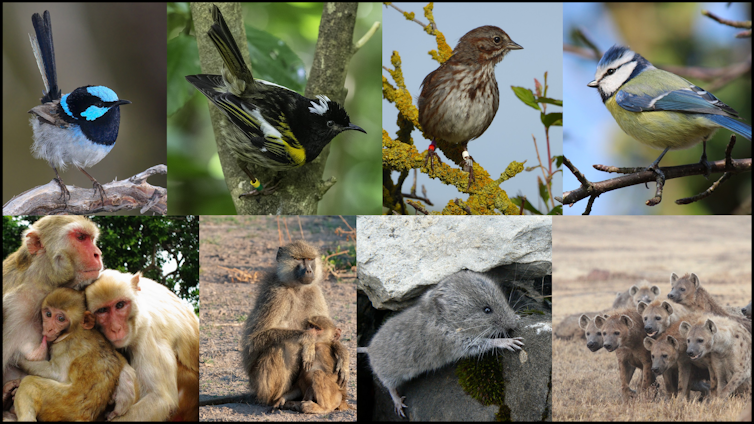
Nosotros worked with 27 inquiry institutions to assemble data from 19 wild populations that have been monitored for long periods of time, some since the 1950s. Generations of researchers collected information about the birth, mating, reproduction and death of each individual in these populations.
Together, those data represent effectually 250,000 animals and 2.half dozen million hours of field work. The investment may look outrageous, simply the data take already been used in thousands of scientific studies and volition be used again.
Statistics to the rescue
Nosotros then used quantitative genetic models to apply the "fundamental theorem" to each population. Instead of keeping track of changes in every cistron, quantitative genetics uses statistics to capture the cyberspace effect emerging from changes in thousands of genes.
We likewise developed a new statistical method that fits the data better than previous models. Our method captures two primal properties of how survival and reproduction are unevenly distributed across populations in the wild.
Kickoff, almost individuals die earlier breeding, meaning at that place are a lot of entries in the "goose egg offspring" cavalcade of the lifetime reproduction record.
2nd, whereas nigh breeders accept only a few offspring, some accept a disproportionately high number, leading to an asymmetric distribution.
The rate of evolution
Among our 19 populations, we found that, on average, genetic change in response to selection was responsible for an 18.5% increment per generation in the ability of individuals to survive and reproduce.
This ways offspring are on average 18.5% "better" than their parents. To put it another way, an average population could survive an 18.5% deterioration in the quality of its environment. (This may change if genetic response to choice is not the only force at play; more on that below.)
Given these rates, nosotros found adaptive development could explain most recent changes in wild fauna traits (such as size or reproductive timing). Other mechanisms are important besides, but this is strong evidence development should be considered alongside other explanations.
An exciting result for an uncertain hereafter
What does this mean for the time to come? At a fourth dimension when natural environments are irresolute dramatically all over the globe, due to climatic change and other forces, will evolution help animals adjust?
Unfortunately, that is where things get tricky. Our inquiry estimated only genetic changes due to natural selection, but in the context of climatic change there are other forces at play.
First, in that location are other evolutionary forces (such as mutations, random chance and migration).
Second, the ecology modify itself is likely a more than of import driver of population demographics than genetic change. If the environment keeps deteriorating, theory tells u.s. that adaptive evolution will by and large exist unable to fully compensate.
Baca juga: Life rapidly finds a style: the surprisingly swift cease to evolution's big bang
Finally, adaptive evolution can itself change the surroundings experienced by hereafter generations. In particular, when individuals compete with each other for a resource (such as nutrient, territory or mates), whatever genetic improvement volition lead to more competition in the population.
Our work alone is insufficient to draw predictions. Nonetheless, it shows that evolution cannot be discounted if we want to accurately predict the virtually hereafter of animal populations.
Despite the applied challenges, we are thrilled to witness Darwinian evolution, a process once thought exceedingly slow, acting observably in our lifetimes.
Source: https://theconversation.com/wild-animals-are-evolving-faster-than-anybody-thought-183633
Posted by: mabreyyoulded.blogspot.com
0 Response to "What Animals Have Evolved Dramatically Over Time"
Post a Comment