

How Do Animals And Plants Benefit From One Another?

Mutualism describes the ecological interaction betwixt 2 or more species where each species has a cyberspace benefit.[one] Mutualism is a common type of ecological interaction. Prominent examples include most vascular plants engaged in mutualistic interactions with mycorrhizae, flowering plants being pollinated past animals, vascular plants being dispersed by animals, and corals with zooxanthellae, amongst many others. Mutualism tin can be contrasted with interspecific contest, in which each species experiences reduced fitness, and exploitation, or parasitism, in which one species benefits at the "expense" of the other.
The term mutualism was introduced by Pierre-Joseph van Beneden in his 1876 book Animal Parasites and Messmates to mean "mutual assistance amidst species".[2] [3]
Mutualism is often conflated with two other types of ecological phenomena: cooperation and symbiosis. Cooperation well-nigh ordinarily refers to increases in fettle through inside-species (intraspecific) interactions, although information technology has been used (especially in the past) to refer to mutualistic interactions, and it is sometimes used to refer to mutualistic interactions that are not obligate.[1] Symbiosis involves 2 species living in close physical contact over a long catamenia of their existence and may exist mutualistic, parasitic, or commensal, so symbiotic relationships are not always mutualistic, and mutualistic interactions are not always symbiotic. Despite a different definition between mutualistic interactions and symbiosis, mutualistic and symbiosis have been largely used interchangeably in the past, and confusion on their use has persisted.[4]
Mutualism plays a key part in environmental and evolution. For example, mutualistic interactions are vital for terrestrial ecosystem function as about fourscore% of land plants species rely on mycorrhizal relationships with fungi to provide them with inorganic compounds and trace elements.[5] Equally another example, the estimate of tropical rainforest plants with seed dispersal mutualisms with animals ranges at least from lxx–93.5%.[vi] In addition, mutualism is thought to have driven the evolution of much of the biological variety we see, such equally flower forms (of import for pollination mutualisms) and co-evolution between groups of species.[vii] Mutualism has too been linked to major evolutionary events, such as the development of the eukaryotic cell (symbiogenesis) or the colonization of land by plants in clan with mycorrhizal fungi.
Types [edit]
Resource-resources relationships [edit]
Mutualistic relationships can be thought of as a grade of "biological barter"[viii] in mycorrhizal associations between constitute roots and fungi, with the plant providing carbohydrates to the fungus in render for primarily phosphate only as well nitrogenous compounds. Other examples include rhizobia bacteria that fix nitrogen for leguminous plants (family Fabaceae) in return for free energy-containing carbohydrates.[ix]
Service-resources relationships [edit]
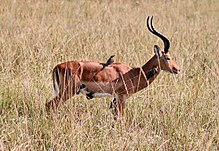
Service-resource relationships are mutual. Three important types are pollination, cleaning symbiosis, and zoochory.
In pollination, a plant trades food resources in the class of nectar or pollen for the service of pollen dispersal.
Phagophiles feed (resource) on ectoparasites, thereby providing anti-pest service, as in cleaning symbiosis. Elacatinus and Gobiosoma, genera of gobies, feed on ectoparasites of their clients while cleaning them.[x]
Zoochory is the dispersal of the seeds of plants by animals. This is similar to pollination in that the establish produces food resources (for example, fleshy fruit, overabundance of seeds) for animals that disperse the seeds (service). Plants may advertise these resources using colour [11] and a diverseness of other fruit characteristics.
Another type is ant protection of aphids, where the aphids trade sugar-rich honeydew (a by-product of their way of feeding on establish sap) in return for defense against predators such every bit ladybugs.
Service-service relationships [edit]
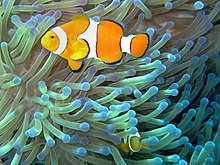
Strict service-service interactions are very rare, for reasons that are far from clear.[8] Ane example is the relationship between bounding main anemones and anemone fish in the family Pomacentridae: the anemones provide the fish with protection from predators (which cannot tolerate the stings of the anemone's tentacles) and the fish defend the anemones against butterflyfish (family Chaetodontidae), which consume anemones. However, in mutual with many mutualisms, there is more than ane aspect to it: in the anemonefish-anemone mutualism, waste ammonia from the fish feeds the symbiotic algae that are found in the anemone's tentacles.[12] [13] Therefore, what appears to be a service-service mutualism in fact has a service-resources component. A 2d example is that of the relationship between some ants in the genus Pseudomyrmex and trees in the genus Acacia, such as the whistling thorn and bullhorn acacia. The ants nest within the establish's thorns. In exchange for shelter, the ants protect acacias from assault by herbivores (which they frequently eat when those are small plenty, introducing a resource component to this service-service relationship) and competition from other plants by trimming dorsum vegetation that would shade the acacia. In addition, another service-resources component is present, every bit the ants regularly feed on lipid-rich food-bodies called Beltian bodies that are on the Acacia found.[xiv]
In the neotropics, the ant Myrmelachista schumanni makes its nest in special cavities in Duroia hirsute. Plants in the vicinity that belong to other species are killed with formic acid. This selective gardening can be so aggressive that small areas of the rainforest are dominated by Duroia hirsute. These peculiar patches are known by local people as "devil'due south gardens".[fifteen]
In some of these relationships, the cost of the ant'south protection can be quite expensive. Cordia sp. copse in the Amazonian rainforest have a kind of partnership with Allomerus sp. ants, which make their nests in modified leaves. To increment the amount of living space available, the ants will destroy the tree's flower buds. The flowers dice and leaves develop instead, providing the ants with more dwellings. Another type of Allomerus sp. pismire lives with the Hirtella sp. tree in the same forests, only in this human relationship, the tree has turned the tables on the ants. When the tree is prepare to produce flowers, the ant abodes on certain branches begin to wither and shrink, forcing the occupants to flee, leaving the tree's flowers to develop free from ant attack.[15]
The term "species group" tin exist used to depict the manner in which individual organisms group together. In this non-taxonomic context one can refer to "aforementioned-species groups" and "mixed-species groups." While aforementioned-species groups are the norm, examples of mixed-species groups abound. For example, zebra (Equus burchelli) and wildebeest (Connochaetes taurinus) can remain in association during periods of long distance migration across the Serengeti as a strategy for thwarting predators. Cercopithecus mitis and Cercopithecus ascanius, species of monkey in the Kakamega Wood of Kenya, can stay in shut proximity and travel along exactly the aforementioned routes through the forest for periods of up to 12 hours. These mixed-species groups cannot be explained by the coincidence of sharing the same habitat. Rather, they are created by the active behavioural option of at to the lowest degree one of the species in question.[sixteen]
Mathematical modeling [edit]
Mathematical treatments of mutualisms, similar the study of mutualisms in general, has lagged backside those of predation, or predator-prey, consumer-resource, interactions. In models of mutualisms, the terms "type I" and "type 2" functional responses refer to the linear and saturating relationships, respectively, between benefit provided to an individual of species one (y-axis) on the density of species 2 (x-axis).
Type I functional response [edit]
One of the simplest frameworks for modeling species interactions is the Lotka–Volterra equations.[17] In this model, the modify in population density of the 2 mutualists is quantified as:
![{\displaystyle {\begin{aligned}{\frac {dN_{1}}{dt}}&=r_{1}N_{1}-\alpha _{11}N_{1}^{2}+\beta _{12}N_{1}N_{2}\\[8pt]{\frac {dN_{2}}{dt}}&=r_{2}N_{2}-\alpha _{22}N_{2}^{2}+\beta _{21}N_{1}N_{2}\end{aligned}}}](https://wikimedia.org/api/rest_v1/media/math/render/svg/909bd8d58436177fb520a348b4684d3dad491975)
where
Mutualism is in essence the logistic growth equation + mutualistic interaction. The mutualistic interaction term represents the increase in population growth of species one as a result of the presence of greater numbers of species two, and vice versa. Equally the mutualistic term is ever positive, information technology may lead to unrealistic unbounded growth equally it happens with the simple model.[18] And then, it is important to include a saturation machinery to avoid the problem.
Type Two functional response [edit]
In 1989, David Hamilton Wright modified the Lotka–Volterra equations by calculation a new term, βM/K, to stand for a mutualistic relationship.[xix] Wright besides considered the concept of saturation, which means that with higher densities, there are decreasing benefits of farther increases of the mutualist population. Without saturation, species' densities would increase indefinitely. Because that is not possible due to environmental constraints and conveying capacity, a model that includes saturation would be more authentic. Wright's mathematical theory is based on the premise of a uncomplicated two-species mutualism model in which the benefits of mutualism become saturated due to limits posed by handling time. Wright defines handling time as the time needed to process a nutrient item, from the initial interaction to the start of a search for new food items and assumes that processing of food and searching for food are mutually exclusive. Mutualists that display foraging behavior are exposed to the restrictions on handling time. Mutualism can exist associated with symbiosis.
Treatment time interactions In 1959, C. South. Holling performed his archetype disc experiment that assumed the post-obit: that (1), the number of nutrient items captured is proportional to the allotted searching fourth dimension; and (2), that there is a variable of handling fourth dimension that exists separately from the notion of search time. He and then developed an equation for the Blazon Ii functional response, which showed that the feeding rate is equivalent to

where,
- a=the instantaneous discovery charge per unit
- 10=food item density
- TH=handling fourth dimension
The equation that incorporates Type 2 functional response and mutualism is:
![{\frac {dN}{dt}}=N\left[r(1-cN)+{\cfrac {baM}{1+aT_{H}M}}\right]](https://wikimedia.org/api/rest_v1/media/math/render/svg/18d5e1d77574628a6fea8238dda57cbfc20d1898)
where
- N and M=densities of the two mutualists
- r=intrinsic rate of increase of N
- c=coefficient measuring negative intraspecific interaction. This is equivalent to changed of the carrying capacity, 1/K, of Due north, in the logistic equation.
- a=instantaneous discovery rate
- b=coefficient converting encounters with Thousand to new units of N
or, equivalently,
![{\displaystyle {\frac {dN}{dt}}=N[r(1-cN)+\beta M/(X+M)]}](https://wikimedia.org/api/rest_v1/media/math/render/svg/c37e1855df6b3b221d64349af8299eb47ddc8535)
where
- X=1/a T H
- β=b/T H
This model is most effectively practical to free-living species that encounter a number of individuals of the mutualist function in the course of their existences. Wright notes that models of biological mutualism tend to be similar qualitatively, in that the featured isoclines mostly take a positive decreasing gradient, and by and large similar isocline diagrams. Mutualistic interactions are all-time visualized as positively sloped isoclines, which can be explained by the fact that the saturation of benefits accorded to mutualism or restrictions posed past outside factors contribute to a decreasing slope.
The blazon Ii functional response is visualized as the graph of vs. M.

Construction of networks [edit]
Mutualistic networks fabricated up out of the interaction between plants and pollinators were found to take a similar structure in very dissimilar ecosystems on unlike continents, consisting of entirely dissimilar species.[20] The structure of these mutualistic networks may have large consequences for the fashion in which pollinator communities answer to increasingly harsh weather and on the community carrying capacity.[21]
Mathematical models that examine the consequences of this network structure for the stability of pollinator communities propose that the specific way in which plant-pollinator networks are organized minimizes competition betwixt pollinators,[22] reduce the spread of indirect effects and thus heighten ecosystem stability[23] and may fifty-fifty lead to potent indirect facilitation betwixt pollinators when atmospheric condition are harsh.[24] This means that pollinator species together can survive under harsh conditions. But it also ways that pollinator species collapse simultaneously when conditions pass a disquisitional point.[25] This simultaneous collapse occurs, because pollinator species depend on each other when surviving under difficult atmospheric condition.[24]
Such a community-wide plummet, involving many pollinator species, can occur suddenly when increasingly harsh conditions pass a critical betoken and recovery from such a collapse might not exist easy. The improvement in conditions needed for pollinators to recover could exist substantially larger than the comeback needed to return to conditions at which the pollinator community collapsed.[24]
Humans [edit]
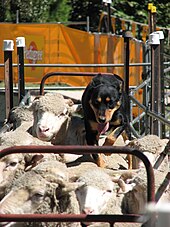
Humans are involved in mutualisms with other species: their gut flora is essential for efficient digestion.[26] Infestations of head lice might take been benign for humans by fostering an immune response that helps to reduce the threat of body louse borne lethal diseases.[27]
Some relationships between humans and domesticated animals and plants are to dissimilar degrees mutualistic. For example, agricultural varieties of maize provide food for humans and are unable to reproduce without human intervention because the leafy sheath does not fall open up, and the seedhead (the "corn on the cob") does not shatter to besprinkle the seeds naturally.[28]
In traditional agronomics, some plants have mutualist equally companion plants, providing each other with shelter, soil fertility and/or natural pest control. For example, beans may grow upwards cornstalks equally a trellis, while fixing nitrogen in the soil for the corn, a miracle that is used in 3 Sisters farming.[29]
One researcher has proposed that the key advantage Homo sapiens had over Neanderthals in competing over similar habitats was the former'south mutualism with dogs.[30]
Development of mutualism [edit]
Evolution past blazon [edit]
Every generation of every organism needs nutrients – and like nutrients – more they need particular defensive characteristics, as the fitness benefit of these vary heavily especially by surroundings. This may be the reason that hosts are more likely to evolve to get dependent on vertically transmitted bacterial mutualists which provide nutrients than those providing defensive benefits. This pattern is generalized beyond bacteria by Yamada et al 2015's demonstration that undernourished Drosophila are heavily dependent on their fungal symbiont Issatchenkia orientalis for amino acids.[31]
Mutualism breakdown [edit]
Mutualisms are not static, and can be lost by development.[32] Sachs and Simms (2006) suggest that this can occur via four main pathways:
- One mutualist shifts to parasitism, and no longer benefits its partner,[32] such as headlice[ citation needed ]
- One partner abandons the mutualism and lives autonomously[32]
- One partner may go extinct[32]
- A partner may be switched to another species[33]
At that place are many examples of mutualism breakdown. For example, constitute lineages inhabiting nutrient-rich environments take evolutionarily abandoned mycorrhizal mutualisms many times independently.[34]
Measuring and defining mutualism [edit]
Measuring the exact fitness benefit to the individuals in a mutualistic relationship is not always straightforward, particularly when the individuals can receive benefits from a variety of species, for example almost plant-pollinator mutualisms. It is therefore common to categorise mutualisms co-ordinate to the closeness of the association, using terms such equally obligate and facultative. Defining "closeness", however, is also problematic. It can refer to mutual dependency (the species cannot live without one some other) or the biological intimacy of the relationship in relation to physical closeness (e.one thousand., 1 species living inside the tissues of the other species).[eight]
See also [edit]
- Arbuscular mycorrhiza
- Co-accommodation
- Coevolution
- Ecological facilitation
- Frugivore
- Greater honeyguide – has a mutualism with humans
- Interspecies advice
- Müllerian mimicry
- Mutualisms and conservation
- Mutual Aid: A Gene of Evolution
- Symbiogenesis
References [edit]
- ^ a b Bronstein, Judith (2015). Mutualism. Oxford University Press.
- ^ Van Beneden, Pierre-Joseph (1876). Animal Parasites and Messmates. London: Henry S. King.
- ^ Bronstein, J. L. (2015). The study of mutualism. Mutualism. Oxford University Printing. ISBN9780199675654. [ page needed ]
- ^ Douglas, Angela East. (December 2014). The Symbiotic Habit. United States: Princeton University Printing. ISBN9780691113425.
- ^ Wang, B. (2006). "Phylogenetic distribution and evolution of mycorrhizas in state plants". Mycorrhiza. 16 (5): 299–363. doi:x.1007/s00572-005-0033-6. PMID 16845554. S2CID 30468942.
- ^ Jordano, P. 2000. Fruits and frugivory. pp. 125–166 in: Fenner, Chiliad. (Ed) Seeds: the ecology of regeneration in plant communities. CABI.
- ^ Thompson, J. Northward. 2005 The geographic mosaic of coevolution. Chicago, IL: Academy of Chicago Press.
- ^ a b c Ollerton, J. 2006. "Biological Barter": Interactions of Specialization Compared across Different Mutualisms. pp. 411–435 in: Waser, N.Grand. & Ollerton, J. (Eds) Plant-Pollinator Interactions: From Specialization to Generalization. University of Chicago Press.
- ^ Denison, RF; Kiers, ET (2004). "Why are most rhizobia benign to their institute hosts, rather than parasitic". Microbes and Infection. 6 (xiii): 1235–1239. doi:x.1016/j.micinf.2004.08.005. PMID 15488744.
- ^ M.C. Soares; I.Chiliad. Côté; S.C. Cardoso & R.Bshary (Baronial 2008). "The cleaning goby mutualism: a system without punishment, partner switching or tactile stimulation" (PDF). Journal of Zoology. 276 (3): 306–312. doi:x.1111/j.1469-7998.2008.00489.x.
- ^ Lim, Ganges; Burns, Kevin C. (24 November 2021). "Do fruit reflectance properties touch on avian frugivory in New Zealand?". New Zealand Journal of Botany: 1–eleven. doi:10.1080/0028825X.2021.2001664. ISSN 0028-825X. S2CID 244683146.
- ^ Porat, D.; Chadwick-Furman, N. Eastward. (2004). "Effects of anemonefish on giant sea anemones: expansion beliefs, growth, and survival". Hydrobiologia. 530 (i–3): 513–520. doi:10.1007/s10750-004-2688-y. S2CID 2251533.
- ^ Porat, D.; Chadwick-Furman, Due north. East. (2005). "Furnishings of anemonefish on giant sea anemones: ammonium uptake, zooxanthella content and tissue regeneration". Mar. Freshw.Behav. Phys. 38: 43–51. doi:10.1080/10236240500057929. S2CID 53051081.
- ^ "Swollen Thorn Acacias". www2.palomar.edu . Retrieved 22 February 2019.
- ^ a b Piper, Ross (2007), Boggling Animals: An Encyclopedia of Curious and Unusual Animals, Greenwood Printing.
- ^ Tosh CR, Jackson AL, Ruxton GD (March 2007). "Individuals from different-looking animal species may group together to confuse shared predators: simulations with artificial neural networks". Proc. Biol. Sci. 274 (1611): 827–32. doi:x.1098/rspb.2006.3760. PMC2093981. PMID 17251090.
- ^ May, R., 1981. Models for Ii Interacting Populations. In: May, R.K., Theoretical Environmental. Principles and Applications, 2d ed. pp. 78–104.
- ^ García-Algarra, Javier (2014). "Rethinking the logistic approach for population dynamics of mutualistic interactions" (PDF). Periodical of Theoretical Biology. 363: 332–343. arXiv:1305.5411. Bibcode:2014JThBi.363..332G. doi:ten.1016/j.jtbi.2014.08.039. PMID 25173080. S2CID 15940333.
- ^ Wright, David Hamilton (1989). "A Simple, Stable Model of Mutualism Incorporating Handling Time". The American Naturalist. 134 (four): 664–667. doi:10.1086/285003. S2CID 83502337.
- ^ Bascompte, J.; Jordano, P.; Melián, C. J.; Olesen, J. M. (2003). "The nested assembly of plant–animal mutualistic networks". Proceedings of the National Academy of Sciences. 100 (16): 9383–9387. Bibcode:2003PNAS..100.9383B. doi:10.1073/pnas.1633576100. PMC170927. PMID 12881488.
- ^ Suweis, Due south.; Simini, F.; Banavar, J; Maritan, A. (2013). "Emergence of structural and dynamical backdrop of ecological mutualistic networks". Nature. 500 (7463): 449–452. arXiv:1308.4807. Bibcode:2013Natur.500..449S. doi:10.1038/nature12438. PMID 23969462. S2CID 4412384.
- ^ Bastolla, U.; Fortuna, M. A.; Pascual-García, A.; Ferrera, A.; Luque, B.; Bascompte, J. (2009). "The architecture of mutualistic networks minimizes contest and increases biodiversity". Nature. 458 (7241): 1018–1020. Bibcode:2009Natur.458.1018B. doi:10.1038/nature07950. PMID 19396144. S2CID 4395634.
- ^ Suweis, S., Grilli, J., Banavar, J. R., Allesina, S., & Maritan, A. (2015) Effect of localization on the stability of mutualistic ecological networks. "Nature Communications", 6
- ^ a b c Lever, J. J.; Nes, E. H.; Scheffer, Thou.; Bascompte, J. (2014). "The sudden collapse of pollinator communities". Environmental Messages. 17 (three): 350–359. doi:10.1111/ele.12236. hdl:10261/91808. PMID 24386999.
- ^ Garcia-Algarra, J.; Pasotr, J. M.; Iriondo, J. One thousand.; Galeano, J. (2017). "Ranking of disquisitional species to preserve the functionality of mutualistic networks using the k-cadre decomposition". PeerJ. v: e3321. doi:10.7717/peerj.3321. PMC5438587. PMID 28533969.
- ^ Sears CL (October 2005). "A dynamic partnership: jubilant our gut flora". Anaerobe. xi (5): 247–51. doi:10.1016/j.anaerobe.2005.05.001. PMID 16701579.
- ^ Rozsa, L; Apari, P. (2012). "Why infest the loved ones – inherent human behaviour indicates erstwhile mutualism with head lice" (PDF). Parasitology. 139 (half dozen): 696–700. doi:10.1017/s0031182012000017. PMID 22309598. S2CID 206247019.
- ^ "Symbiosis – Symbioses Betwixt Humans And Other Species". Net Industries. Retrieved 9 December 2012.
- ^ Mountain Pleasant, Jane (2006). "The science behind the Three Sisters mound arrangement: An agronomic assessment of an ethnic agricultural system in the northeast". In Staller, John East.; Tykot, Robert H.; Benz, Bruce F. (eds.). Histories of Maize: Multidisciplinary Approaches to the Prehistory, Linguistics, Biogeography, Domestication, and Evolution of Maize. Amsterdam: Academic Printing. pp. 529–537. ISBN978-1-5987-4496-5.
- ^ Shipman, Pat (2015). The Invaders: How Humans and Their Dogs Drove Neanderthals to Extinction. Cambridge, Maryland: Harvard University Press.
- ^ Biedermann, Peter H.Westward.; Vega, Fernando East. (vii January 2020). "Environmental and Development of Insect–Mucus Mutualisms". Annual Review of Entomology. Almanac Reviews. 65 (1): 431–455. doi:10.1146/annurev-ento-011019-024910. ISSN 0066-4170. PMID 31610133. S2CID 204704243.
- ^ a b c d Sachs, JL; Simms, EL (2006). "Pathways to mutualism breakdown". TREE. 21 (10): 585–592. doi:10.1016/j.tree.2006.06.018. PMID 16828927.
- ^ Werner, Gijsbert D. A.; Cornelissen, Johannes H. C.; Cornwell, William K.; Soudzilovskaia, Nadejda A.; Kattge, Jens; West, Stuart A.; Kiers, E. Toby (30 April 2018). "Symbiont switching and alternative resources acquisition strategies drive mutualism breakdown". Proceedings of the National Academy of Sciences. National Academy of Sciences. 115 (20): 5229–5234. doi:10.1073/pnas.1721629115. ISSN 0027-8424. PMC5960305. PMID 29712857. S2CID 14055644.
- ^ Wang, B.; Qiu, Y.-L. (half-dozen May 2006). "Phylogenetic distribution and evolution of mycorrhizas in country plants". Mycorrhiza. International Mycorrhiza Order (Springer). xvi (five): 299–363. doi:10.1007/s00572-005-0033-6. ISSN 0940-6360. PMID 16845554. S2CID 30468942.
Farther references [edit]
- Angier, Natalie (22 July 2016). "African Tribesmen Can Talk Birds into Helping Them Find Honey". The New York Times.
- Bascompte, J.; Jordano, P.; Melián, C. J.; Olesen, J. M. (2003). "The nested assembly of plant–beast mutualistic networks". Proceedings of the National Academy of Sciences. 100 (16): 9383–9387. Bibcode:2003PNAS..100.9383B. doi:10.1073/pnas.1633576100. PMC170927. PMID 12881488.
- Bastolla, U.; Fortuna, G. A.; Pascual-García, A.; Ferrera, A.; Luque, B.; Bascompte, J. (2009). "The compages of mutualistic networks minimizes contest and increases biodiversity". Nature. 458 (7241): 1018–1020. Bibcode:2009Natur.458.1018B. doi:x.1038/nature07950. PMID 19396144. S2CID 4395634. * Breton, Lorraine M.; Addicott, John F. (1992). "Density-Dependent Mutualism in an Aphid-Ant Interaction". Ecology. 73 (vi): 2175–2180. doi:10.2307/1941465. JSTOR 1941465.
- Bronstein, JL (1994). "Our electric current understanding of mutualism". Quarterly Review of Biological science. 69 (one): 31–51. doi:10.1086/418432. S2CID 85294431.
- Bronstein, JL (2001). "The exploitation of mutualisms". Environmental Letters. four (iii): 277–287. doi:10.1046/j.1461-0248.2001.00218.x.
- Bronstein JL. 2001. The costs of mutualism. American Zoologist 41 (4): 825-839 Due south
- Bronstein, JL; Alarcon, R; Geber, Yard (2006). "The development of plant-insect mutualisms". New Phytologist. 172 (3): 412–28. doi:10.1111/j.1469-8137.2006.01864.ten. PMID 17083673.
- Denison, RF; Kiers, ET (2004). "Why are most rhizobia beneficial to their plant hosts, rather than parasitic?". Microbes and Infection. half dozen (13): 1235–1239. doi:10.1016/j.micinf.2004.08.005. PMID 15488744.
- DeVries, PJ; Baker, I (1989). "Butterfly exploitation of an pismire-plant mutualism: Adding insult of herbivory". Periodical of the New York Entomological Society. 97 (3): 332–340.
- Hoeksema, J.D.; Bruna, E.M. (2000). "Pursuing the big questions well-nigh interspecific mutualism: a review of theoretical approaches". Oecologia. 125 (iii): 321–330. Bibcode:2000Oecol.125..321H. doi:10.1007/s004420000496. PMID 28547326. S2CID 22756212.
- Jahn, Thou.C.; Beardsley, J.Westward. (2000). "Interactions of ants (Hymenoptera: Formicidae) and mealybugs (Homoptera: Pseudococcidae) on pineapple". Proceedings of the Hawaiian Entomological Society. 34: 181–185.
- Jahn, Gary C.; Beardsley, J. Westward.; González-Hernández, H. (2003). "A review of the association of ants with mealybug wilt disease of pineapple" (PDF). Proceedings of the Hawaiian Entomological Order. 36: 9–28.
- Lever, J. J.; Nes, E. H.; Scheffer, Thousand.; Bascompte, J. (2014). "The sudden collapse of pollinator communities". Ecology Letters. 17 (3): 350–359. doi:10.1111/ele.12236. hdl:10261/91808. PMID 24386999.
- Noe, R.; Hammerstein, P. (1994). "Biological markets: supply and demand determine the effect of partner choice in cooperation, mutualism and mating". Behavioral Environmental and Sociobiology. 35: ane–11. doi:ten.1007/bf00167053. S2CID 37085820.
- Ollerton, J. 2006. "Biological Barter": Patterns of Specialization Compared across Unlike Mutualisms. pp. 411–435 in: Waser, N.M. & Ollerton, J. (Eds) Plant-Pollinator Interactions: From Specialization to Generalization. University of Chicago Press. ISBN 978-0-226-87400-5
- Paszkowski, U (2006). "Mutualism and parasitism: the yin and yang of plant symbioses". Electric current Opinion in Found Biological science. 9 (4): 364–370. doi:x.1016/j.pbi.2006.05.008. PMID 16713732.
- Porat, D.; Chadwick-Furman, Due north. E. (2004). "Effects of anemonefish on giant sea anemones:expansion behavior, growth, and survival". Hydrobiologia. 530 (1–3): 513–520. doi:ten.1007/s10750-004-2688-y. S2CID 2251533.
- Porat, D.; Chadwick-Furman, N. E. (2005). "Effects of anemonefish on giant sea anemones: ammonium uptake, zooxanthella content and tissue regeneration". Mar. Freshw. Behav. Phys. 38: 43–51. doi:10.1080/10236240500057929. S2CID 53051081.
- Thompson, J. N. 2005. The Geographic Mosaic of Coevolution. University of Chicago Press. ISBN 978-0-226-79762-5
- Wright, David Hamilton (1989). "A Simple, Stable Model of Mutualism Incorporating Handling Time". The American Naturalist. 134 (4): 664–667. doi:10.1086/285003. S2CID 83502337.
Farther reading [edit]
- Boucher, D. M.; James, S.; Keeler, K. (1984). "The ecology of mutualism". Annual Review of Environmental and Systematics. 13: 315–347. doi:10.1146/annurev.es.13.110182.001531.
- Boucher, D. H. (editor) (1985) The Biology of Mutualism : Ecology and Evolution London : Croom Helm 388 p. ISBN 0-7099-3238-three
Source: https://en.wikipedia.org/wiki/Mutualism_(biology)
Posted by: mabreyyoulded.blogspot.com
0 Response to "How Do Animals And Plants Benefit From One Another?"
Post a Comment